I’ve been bowhunting whitetails for more than 30 years. Back in the day, we were limited by what we didn’t know. Today, we are limited by the fact that everyone knows everything.
There was a certain grind to planning an out-of-state hunt years ago. Most of the time, it started with a story you heard from a friend, or one they heard from a guy at the archery club.
You’d spread paper maps across the kitchen table, call state agencies for information, and wait for brochures to show up in the mail.
You might knock on doors for permission or spend years saving for an outfitted hunt. Now, you can do it all from your couch in an afternoon.
Modern hunters locate public lands, analyze topography, identify bedding areas, and drop pins with tools like HuntStand, all while watching countless YouTube videos breaking down the best times and methods for hunting each State.
Figuring out when and how to apply for tags and permits is a quick Google search away.
DIY public-land hunting has exploded in popularity among bowhunters, and for good reason. It’s easier than it’s ever been, and it’s a heck of a lot of fun.
With more hunters than ever targeting public ground, states like Missouri are starting to take notice and take action.
The barrier to entry for out-of-state hunting is lower than ever, making it more popular than ever. Staff illustration.
Missouri Hits the Brakes
Missouri has seen non-resident deer hunters jump from roughly 20,000 per year in the early 2000’s to over 42,000 today. That’s nearly a 45% increase in the last decade alone.
Many of those new hunters are packing into public lands, eager for their shot at a rutted-up Midwest whitetail.
In light of this increase, the Missouri Department of Conservation (MDC) is proposing a series of changes that will fundamentally reshape non-resident hunting in the Show-Me State.
2026: Reduce the non-resident antlered buck limit from two to one
2027: Introduce a $165 non-resident public land permit
Beyond 2027: Explore a lottery draw system for non-residents
At face value, these proposals may seem like ordinary regulation changes. But many hunters are asking whether they’re really aimed at conservation or if they’re a way to discourage the growing wave of out-of-state hunters heading to Missouri each fall.
Why Missouri is Pulling the Emergency Brake
According to MDC Deer and Elk Program Leader Jason Isabelle, this isn’t about herd health; it’s about pressure.
When I asked Isabelle about the first 2026 change of limiting non-residents to one buck, he explained, “This one is really about trying to manage access and provide our residents with quality hunting opportunities.”
Translation: The woods are getting crowded, and Missouri residents are feeling it.
He then explained that Missouri residents have reported public parking lots filled with out-of-state plates, leaving little room for them to hunt in their own backyard.
Private land is being leased at higher rates, and permission ground is quickly disappearing.
The surge in public land hunters, especially non-residents, didn’t happen by accident.
The Information Highway
It’s impossible to ignore how digital tools have made finding and hunting deer more efficient than ever. What once required years of boots-on-the-ground scouting can now be done from a smartphone.
Alex Chopp hosts Latitude’s Grit video series and has built a career traveling the country hunting public land.
He put it plainly: “Tools like GPS hunting apps have removed the barrier, allowing hunters to do much of the legwork before ever setting foot in a new area.”
Unfettered access to information has inspired an entire generation of hunters like Alex to start businesses tailored to mobile hunters and seek adventures in faraway places that once seemed impossible.
Digital scouting has replaced physical scouting. And when everyone has access to the same information, they end up in the same places.
States can’t control what information videos are on the internet, and they can’t regulate mapping apps. So, naturally, they regulate access.
Bowhunt or Die co-host Justin Zarr has seen this evolution firsthand. ‘We spent decades trying to make hunting more accessible through content. First, it was articles and blogs; then, social media posts; and now, YouTube videos and hunting apps’, Zarr notes.
‘Now, we’re seeing the unintended consequence: the democratization of the “secret spot.”
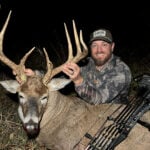
Zarr harvested this great buck on Kansas public land in 2025. With great bucks like this roaming around, it’s easy to see the attraction of DIY hunting adventures.
The Regional Domino Effect
Missouri isn’t alone. Look around the Midwest, and the writing is already on the wall.
Kansas has tightened non-resident opportunities, Iowa’s draw system now takes significantly more preference points than it did just a decade ago, and Illinois recently sold out of non-resident tags for the first time in recent memory.
With unlimited over-the-counter tags and a relatively affordable price compared to our neighbors, Missouri has seen tremendous growth in non-resident hunting. It was only a matter of time before this bubble burst.
What Missouri is proposing isn’t an outlier; it’s the next step.
Resident vs. Non-Resident: The Breaking Point
This issue goes beyond simple hunter numbers; it’s about social carrying capacity.
There comes a point when resident hunters begin to feel like the public ground their tax dollars fund, and that they’ve hunted for years, no longer feels like their own.
Living in southern Missouri, I’ve personally felt that frustration while watching an increasing number of out-of-state hunters fill the areas I’ve turkey-hunted for the past 30 years.
I care deeply about hunting and want to see it grow, but there’s also a reality that increased pressure will eventually become a problem.
MDC’s Jason Isabelle hears it constantly. Public land hunters say they can’t find a spot, private land hunters are losing access to leases, and there is rising frustration over out-of-state pressure.
Isabelle made it clear that MDC isn’t anti-non-resident.
“Non-resident hunters bring real value, tourism dollars, local spending, and lease income for landowners,” But as Isabelle described it, it’s a balancing act. And right now, the scale is tipping.”
The YouTube Effect
Here’s the uncomfortable truth: the same content that’s grown hunting has also concentrated it. Public land hunting has become a movement, a lifestyle, a challenge.
Chopp says that’s not necessarily a bad thing. “Mobile hunting delivers new terrain; it’s far more engaging than repeating the same property.”
He’s right. The rise of DIY, public-land, run-and-gun hunting has brought new energy to the sport. But it’s also brought more people to fewer places.
Zarr adds, “As a media outlet, we have to look in the mirror and understand our role in all of this. When we talk about the great public land hunting opportunities and show big bucks, we increase awareness and focus on these areas and resources.
I’m willing to accept some measure of responsibility while also pointing out that this new wave of information has enabled people to succeed and have experiences they might not otherwise have had. Gatekeeping information may help a few people, but sharing it helps far more.”
Widely considered the pioneers of the public-land whitetail hunting YouTube community, The Hunting Public has inspired thousands of hunters to hit the road in search of big bucks and hunting adventures. But that inspiration may now come with a cost.
Fee or Draw: Pick Your Poison
Missouri is considering two options: pay more via the $165 public land permit, or hunt less often via a lottery system. Or a combination of both.
Even among traveling hunters, there’s division. Chopp says he sees both sides.
“If this is more about resident hunters feeling crowded, I’m in favor of the fee. It’s reasonable for non-residents to contribute.” But he also warns about the bigger picture.
“Limiting opportunity accelerates the death of the hunting culture we all value.” That’s the tension. Do you reserve access, or preserve experience?
The Blue-Collar Squeeze
For the average DIY hunter, this hits hard. The Midwest has long been the blue-collar hunter’s destination, a place where you didn’t need connections or deep pockets to chase big whitetails.
But that window may be closing. The cost of traveling to hunt is quickly rising. Non-resident tags, travel expenses, lodging, and now, potentially, a $165 access fee, or worse, waiting years to draw a tag. What used to be an annual trip could become a once-every-few-years opportunity.
Todd Graf, co-host of the Watering Hole podcast, recently commented on the idea of charging non-resident hunters an additional fee to hunt public lands.
“Going on an out-of-state hunt is already expensive. Between tags and permits, fuel, gear, hotels, and food, you’re already spending a lot of money. A $165 permit isn’t going to deter enough hunters to combat the growing pressure problem.”
Is It Just A Money Grab?
Some hunters will call this a cash grab, but the reality is more complicated than that.
Missouri’s proposed fee brings total non-resident costs in line with neighboring states, and the additional revenue goes back into conservation.
MDC’s Isabelle explained that Missouri has often been one of the least expensive states to hunt, making it attractive to more people.
With the proposed $165.00 public land access fee and the cost of a non-resident hunting license, Missouri would be competitive with other states.
Again, this isn’t being driven by biology; it’s being driven by people. More specifically, too many people in the same places at the same time.
Click chart to view larger
How Does This Affect The Future of DIY Hunting?
This isn’t the end of DIY hunting, but it may be the end of easy DIY hunting.
For decades, the Midwest was the great equalizer. You didn’t need a trust fund to chase world-class whitetails; you just needed a truck, a tent, and a week of vacation.
The democratization of information has brought that era to a close. We are witnessing a fundamental “correction” to a sport that grew faster than the resources could handle.
The Bigger Question
At its core, this debate centers on who public land is meant to serve.
Public land has long been viewed as a resource open to everyone, regardless of where they live, but many believe states also have a responsibility to prioritize the hunters who call that State home.
What Happens Next?
However you view it, the debate over nonresident access is no longer hypothetical. Hunters are voicing their concerns, and States aren’t just listening, they’re taking action.
As a Missouri resident and avid public land bowhunter, I believe the Missouri Department of Conservation is making a genuine effort to balance opportunity while addressing growing concerns from resident hunters.
Is there a solution out there that everyone will be happy with? Of course not. There never is.
Whether nonresidents see it as fair management or simply another barrier to entry, one thing is certain: the era of affordable, unlimited DIY public-land hunting opportunities is quickly coming to an end.