
Fewer topics in life are debated more than bowhunting equipment and archery trends (besides politics). Don’t believe me? Feel free to check out the comment section on any YouTube, Facebook or Instagram post.
Whether it is Fixed blade vs. Mechanical Broadheads, Treestands vs. Saddles or dare I say, Light Weight vs. Heavy Weight arrows, everyone feels obligated to voice their own highly opinionated take on the matter. You know what they say about opinions, everyone has one and they all stink!
First, let me preface this piece by stating that I am not a Physics Guru. In fact, far from it. I, probably like yourself, am just an average, everyday normal bowhunter who has always been curious about new gear and today’s trends.
So, if you are looking for specific scientific information on heavy weight arrows, I suggest Google searching Dr. Ed Ashby and the Ashby Bowhunting Foundation. There you can nerd out on a lifetime of research, reports and data about heavy arrows tested by Dr. Ashby himself and the factors involved in making them lethal.
5 years ago, I jumped aboard the “heavy arrow train” and built a 545 grain arrow. Since then, I have experimented with several different heavy arrow builds on big bodied, midwestern whitetails with interesting results.
In this article, I will define what is commonly considered to be a heavy arrow, why some bowhunters have a fascination with them, provide several pros and cons for such an arrow build, and give my thoughts, as well as the thoughts of a few other bowhunters, on whether heavy arrows are overrated or underrated.
So, without further ado, let’s dive into it.
Are Heavy Arrows Overrated or Underrated?
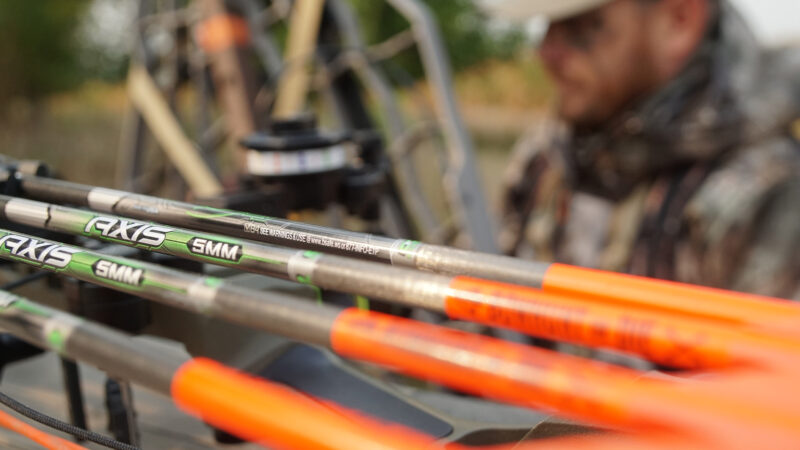
What is a Heavy Arrow?
So, what is considered a heavy arrow? Personally, I consider an arrow setup as “heavy” when it crosses 500 grains of total arrow weight with a high Forward of Center percentage (F.O.C.). Total arrow weight is the measurement from tip to tail of the projectile and the components involved.
This includes the broadhead, insert, carbon to carbon grains per inch (GPI), and the nock. Most whitetail hunting arrow setups average 400-450 grains and with the raging comeback of heavy weight arrows, it is not uncommon to find hunters building 500, 600, or even heavier weight arrows for big game animals.
In 2020, I found myself experimenting with a 545 grain arrow. In 2023 I chose a 603 grain arrow to take to the field in the fall. Today, I’ve settled in between with a total arrow weight of 573 grains, a sweet spot for my personal setup and style of close encounter whitetail bow hunts.
For some bowhunters, the heavy weight arrow may sound like a new movement, but for others, this is a debate that has been fueled by bowhunters for decades. Believe it or not, years ago, heavy arrows were once common in quivers across the nation.
Due to the lack of technology and advanced, lightweight materials, such as carbon fiber, hunters often found themselves afield with a quiver full of arrows like the Aluminum Easton XX75 Gamegetter. A legendary arrow that has arguably taken more wild game than any other arrow made. It could safely be considered the Mike Tyson of heavy hitting aluminum arrows.
These aluminum projectiles sported a hefty GPI that ranged from 10.6 in a 500 spine arrow up to 13.3 GPI in a 300 spine. Therefore, total arrow weight was inherently high whether you planned it to be or not.
When light weight carbon fiber arrows hit the market, the archery industry swung like a pendulum, quickly swinging the trend from heavy hitting, slow and steady setups to light weight, flat shooting, overdraw, speed setups. Funny enough, decades later, we find ourselves swaying back towards a heavy arrow trend.
Benefits of a Heavy Arrow Setup
Big game animals have big bones. As bowhunters, we try our best to avoid these bones when trying to make clean, ethical kills. Unfortunately animals, by design, have their most lethal vitals guarded by shoulder blades, leg bones and in some species, a thick, hard to penetrate cage of ribs.
They often refuse to stand still like our backyard 3D targets, and the bullseye can move when the arrow is in flight; something we as hunters have no control over. So, to breach big bones, a sufficient setup must be in place.
The first advantage to a heavy arrow setup is increased penetration down range. Higher inertia means that the arrow will carry more momentum down range and will subsequently retain more energy as it begins to pass through the target, giving you a higher likelihood of passing through the animal.
Another benefit to a heavy arrow is that they are less susceptible to wind drift due to the increased momentum. This amplified momentum fights the forces exerted from crosswind shearing meaning better and more accurate arrow flight on windy days. This increased momentum will also help the arrow track better if small obstacles are met along the way such as grass or small stems.
Lastly, a heavy arrow can quiet the bow and reduce its vibration. This occurs because the bow transfers more energy into the heavier projectile causing less vibration to be exerted throughout the bow and ultimately making your shot quieter.
Disadvantages of a Heavy Arrow Setup
Sounds too good to be true, right? Like many things in life, there are always drawbacks. So, if you are thinking of trying a heavy arrow setup this fall, here are a few things to keep in mind that you will be sacrificing.
The first disadvantage of a heavy arrow is trajectory. It shouldn’t come as a surprise that reduced arrow speed means a higher arching trajectory. The higher the arrow mass, the higher the arrow arch.
This comes into play in tight windows, thick brush, and long range shooting. So, if that is a hunting situation in which you find yourself in often then this is something to take note of.
A heavy arrow is also less forgiving when it comes to misjudging yardage due to the arrow dropping faster because of its weight. It’s important to have an accurate range if you plan to take a long distance shot with a heavy arrow setup.
The final downfall of the heavy arrow is again due to the speed of the arrow. More time in flight means more time for the target you are shooting at to have moved by its arrival. In a game of inches, a moment like this can mean the difference filling a tag or going home empty handed.

What Hunters Are Saying
Want to know what other bowhunters think about heavy arrows? Just ask!
And who better to ask than a hunting guide or outfitter who deals with a long list of bowhunters every season? So we asked, Paul Morrison, guide from Big Horn Outfitters in Wyoming, what he thought about heavy arrows and if he considered them overrated or underrated.
“As a guide, I feel like extra heavy arrows are overrated,” says Morrison. “Somewhere between 400 to 500 total grains is perfect. We run into more accuracy problems than we do penetration problems.”
For some bowhunters, that last sentence might sting a bit.
For many bowhunters, shooting a heavy arrow easily becomes a band-aid for the greater problem – lack of shooting skills. There are plenty of shooters than simply need to focus more on accuracy than they do penetration.
Parker McDonald of the Southern Collective says he’s chased the heavy arrow wagon like a lot of other bowhunters and admits that their performance is impressive when the arrow made contact with his aiming point. However, his issue with heavy arrows comes from a different perspective.
“My main problem was that if I misjudged the yardage by 3 or 5 yards it would be either a terrible shot or a complete miss,” says McDonald. “Pin gaps were gigantic and unrealistic for most bowhunting scenarios. That kind of starts a chain of bad things when it comes to single bevel and other two blade fixed heads, because if you don’t hit them in the right spot, you’ll probably wish you had a mechanical.”
Longtime bowhunter, Efton Green, says he feels heavy arrows tend to be underrated. “From my experience, a heavy setup, like the 550-grain arrows I’m shooting now, deliver far better penetration than a lighter setup,” says Green. “It’s not just about speed. The added weight drives the arrow deeper, carrying more momentum than lighter arrows can accomplish.”
In a recent Outdoor Life podcast interview with Levi Morgan, Levi shared that he’s somewhere in the middle. He aims for a balanced compromise between arrow weight and speed.
“I don’t want to be shooting 330 fps with a 350-grain arrow when I could be shooting 300 fps with a 400-grain arrow – and I don’t want to be shooting 240 fps either,” he said.
Morgan says his sweet spot for arrow weight is 450 to 500 grains, delivering speeds between 290 and 310 fps
Final Thoughts
So what are my final thoughts on the heavy arrow craze? After tinkering with different weights and configurations, I can tell you this – diving into a heavy arrow build made me a better bowhunter overall.
At the end of the day, bowhunters have many opinions. Our sport is diverse. No 2 situations are the same. That is why it is critical to do your research, find your niche, and tailor your arrow setup to give you the most benefit for whatever situation you find yourself in.
For me this fall, I’ll be heading to the stand with confidence in my heavy arrow setup, dreaming of that 20 yard shot on a Illinois giant.