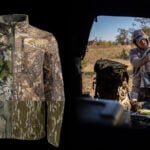
Imagine this. You’re perched in your treestand on a calm November morning. The woods are still. You’ve taken the precautions to be as scent-free as possible.
You showered with scent-killing soap, sprayed your boots, and even sprayed the outside of your carbon-lined camo, even though it’s probably not necessary. But you do it for extra protection.
And then you hear it. A snort behind and to your left. You turn just in time to see a massive set of antlers bounding away through the brush and your heart sinks. What happened? You notice the tiniest breeze pushing your frosty breath in the direction the deer had approached. Surely that wasn’t enough for that buck to wind you…was it?
I’ve been in that situation and know the disappointment, and I’m betting you do, too. Sometimes it feels like you can do everything right, and it’s still not enough. There’s no doubt about it, the whitetail’s nose is its superpower, and trying to beat it can be as futile as trying to hide from Superman’s x-ray vision.

The Nose Knows
Let’s look at the basic biology of a whitetail deer’s nose. They have long, complex nasal cavities packed with nearly 300 million olfactory receptors, compared to a human’s five million. Research suggests their sense of smell is anywhere from 500-1,000 times greater than ours, and their olfactory system is known to be one of the most sophisticated in the entire animal kingdom.
But what does that mean in practical terms?
According to studies cited by the Mississippi State University (MSU) Deer Lab, whitetail deer are capable of detecting scent from over a quarter mile away (400+ yards) in optimal conditions. In prime circumstances with a steady wind, they may even detect your presence from a half mile away or more.
In other words, there’s little chance that any deer traveling downwind won’t smell a hunter, even if that hunter has taken drastic measures to be scent free. However, there’s a catch – maybe even two catches.
First, every whitetail has varying tolerances for human scent. For instance, deer living in urban areas where human presence is common may not be as alarmed when they encounter human scent. Their reaction to that scent can also vary depending on factors such as weather, time of year, intensity, etc., which we’ll discuss in just a moment.
Second, some hunters stink more than others. And no, I’m not just talking about those who use odor-eliminating products versus those who do not. I’m referring to the inherent natural smell of each individual hunter.
That smell is comprised of volatile organic compounds (VOCs) that emanate from our skin, hair, mouth, fingernails, and even our eyeballs and ears. According to researchers at MSU, every human being gives off a unique scent. Our skin and breath emit literally hundreds of VOCs that fill the air around us, and it varies based on when we eat, drink, exercise, and rest.
Now here’s something else to consider in regard to why scent is such a big deal: sense of smell is the sense most tied to emotion and memory.
An article in Harvard Medicine: The Magazine of Harvard Medical School reports that when molecules enter our nose, a chain of reactions takes place: olfactory sensory neurons fire electrical signals along axons to different parts of the brain. These signals are filtered through the olfactory bulb before traveling to key areas of the brain involved in learning, emotion, and memory.
According to the article, if a smell is connected to a particularly emotional moment, our brain’s hippocampus can file the information and store it indefinitely. In fact, even decades later, that same scent can evoke a strong reaction and cause memories to come flooding back.
If science has found this to be true in human beings, imagine how a whitetail, which has sense of smell 5,000-10,000 times greater than ours, might react to a particular scent it has deemed dangerous!
This could possibly explain why some deer seem less “triggered” than others when they catch our wind while others absolutely freak out. How deer respond to a hunter’s scent could be directly related to any negative encounters they may have had in the past.
What Influences How Far Scent Travels?
So, if a deer can smell you from a quarter mile away, when can you actually consider yourself “in the clear?” The truth is, it depends on several interacting factors. Here are the three biggest ones:
Wind direction and wind speed. This is the number one factor in determining how far and how fast your scent travels. A steady breeze acts like a conveyor belt dispersing scent molecules for several hundred yards straight downwind. A gusty or swirling wind pushes that scent in multiple and unpredictable directions. Even a light, consistent wind can carry scent farther than we realize. In fact, MSU researchers have noted that on flat ground with a moderate 5-10 mph wind, scent molecules can easily travel up to 500 yards.
Terrain and vegetation. Topography plays a huge role in how scent disperses across the landscape, carrying farther in open or flat terrain versus being more contained in dense forests or brushy gullies. Also, thermals can play a huge role in how scent travels. These natural air currents rise and sink according to air temperature and foil many hunts even when there’s no perceivable wind.
Weather and humidity. High humidity holds scent molecules better and prevents them from evaporating. Heavy rain, of course, can wash away our scent, and even a light rain can dilute it enough to make it negligible. And MSU scent control studies show deer were still able to detect low-level human VOCs in extremely dry conditions, albeit at shorter ranges.
What Does This Mean for Hunters?
The key takeaway from what we’ve discussed here is this: If a deer is downwind, even a few hundred yards downwind, it can smell you. Period.
The best way to avoid getting winded is to select stand locations that naturally reduce your chances of being winded. For instance, set up on the downwind side of a travel corridor or food plot.
Also, carefully select the routes you take to and from those stands, and don’t spend too much time wandering through your hunting area without a purpose. The more time we spend in an area, the stronger the scent we leave behind.
And yes, scent-killing products are still valuable. They may not eliminate every odor, but MSU researchers have discovered that sprays were effective at reducing the levels of 29 key compounds, either by killing the responsible bacteria, binding to the chemicals, or converting them into less volatile compounds.
These may not be huge advantages, but they could mean the difference between a deer bolting out of there at the slightest whiff of a hunter’s scent versus sticking around just long enough for us to get a shot.
A whitetail’s nose is its superpower. Their sense of smell is their first line of defense. Not only is it more biologically advanced in terms of its capability to detect danger, but it likely operates on an instinctive level that we may not even understand yet.
My guess is that, for most whitetail deer (and maybe even more so for mature bucks), one encounter with a hunter’s scent likely leaves a memory that lasts their lifetime.
So next time you’re on stand wondering if a deer can smell you, perhaps ask yourself a different question: “Where is my scent going, and how do I make sure it never reaches the deer?” Because until then, you’ll never be in the clear.