Getting to full draw on a turkey is the most critical step in closing the deal.
Bowhunting spring gobblers is a close quarters chess match. Hunters typically only get a single shot, and unlike deer, turkeys rarely stand still or offer forgiving angles. Typically, hunters set up on the ground, whether in a blind, against a tree or brush pile, or in the open, and from those unforgiving angles, the shooting position can make or break the hunt.
While hunting an old high school friend’s farm, I got caught in a narrow fence line separating two fields. Luckily for me, the fence line had a few small trees, providing just enough cover. While running and gunning to try to locate a tom, a gobble rang out at the back side of the field.
I knew at any minute, the tom was going to walk out in the open. If I was going to get a shot opportunity, I needed to sit down right then.
As the tom stepped into the field, I made a few soft yelps with my mouth call. After gobbling back at my hen call, he quickly waddled his way closer, like a penguin going across the ice. Unfortunately, the tom took a route that left me twisted like a pretzel.
I drew my bow, then turned slowly to my right to get into position. The muscle in my side pulled to an uncomfortable feeling, yet I stayed at full draw, while the tom strutted around looking for the hen.
What was only a minute or two seemed like hours with cramping muscles and one of the most awkward and uncomfortable positions I had ever drawn my bow in.
I finally made the shot on a great, three year old tom.
After my hunt and the weird shooting position, I was reminded how important a proper shooting position is when turkey hunting with a bow. Although most hunters probably never practice the stance I had to make, practicing from real world positions is just as important as tuning broadheads, proper arrows, and everything else archery hunters prepare before a hunt.
Below are the most common shooting positions for bowhunting turkeys, along with the pros, cons, and when each position shines.
On Your Knees
Kneeling is the go-to for hunters who like to stay mobile. This is what I attempted on that fence line before I got caught in my tracks.
HOW IT WORKS: You’re on one or both knees, back against a tree. The bow stays upright, and you shoot through small gaps in the brush.
PROS: It’s a natural move for quick shots and keeps your profile low while allowing a full draw. It’s also the easiest position to pivot from.
CONS: It’s brutal on the joints during long sits and less stable than a chair.
BEST FOR: Run-and-gun hunters and public land setups where you need to move fast.
Shooting from your knees is one of the most versatile shooting positions outside of a blind.
Sitting Flat on the Ground
This is the minimalist approach—the classic shotgun hunter’s “butt in the dirt” style. It allows you to disappear into the base of a tree.
HOW IT WORKS: Seated directly on the ground, legs extended or slightly bent.
PROS: Extremely low profile. It’s quiet, simple, and offers excellent concealment when drawing.
CONS: It kills your mobility. Rotating for an off-angle shot is nearly impossible without spooking the bird.
BEST FOR: Ambush setups and field edges.
REALITY CHECK: Let’s be honest—this one is mostly for the 40-and-under crowd.
From a Turkey Chair
Low-profile turkey chairs like Hunter Specialties Strut Seat have changed the game for bowhunters who value their backs.
HOW IT WORKS: A specialized low chair keeps you a few inches off the ground.
PROS: Massive comfort for all-day sits. It provides a consistent anchor point and makes the draw cycle much smoother than sitting in the dirt.
CONS: It’s one more piece of gear to carry, and you have a slightly higher silhouette.
BEST FOR: Decoy setups and hunters over 40 who want to stay mobile without the back pain.
Just getting a few inches off the ground can make a huge difference in comfort.
Seated in a Ground Blind
This is arguably the most effective way to bowhunt turkeys. If you want to get away with movement, this is your best bet.
HOW IT WORKS: You’re on a chair or stool inside a darkened hub-style blind.
PROS: Maximum concealment. You can check your phone, eat a snack, and—most importantly—draw your bow without the bird ever knowing you’re there.
CONS: You lose mobility. If the bird hangs up 60 yards behind the blind, you’re stuck.
BEST FOR: Filming your hunts, taking kids, or rainy spring mornings.
Nothing beats the comfort & concealment of a ground blind, but they're not always practical.
Practice Like You Hunt
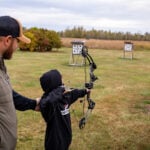
Shooting tight groups at 20 yards while standing in your backyard doesn’t mean much when a gobbler is at eight steps and you’re kneeling in the mud.
Practice from your knees. Practice sitting flat on your butt. Most importantly, practice drawing slowly and holding that weight for two or three minutes.
Turkeys demand precision and patience. There is no single “best” position—there is only the one you’ve actually practiced. Dial in your setup now, so when the woods turn electric this spring, you’re ready to make it count.