Blindless Bowhunting for Turkeys

By April 13, 20261 Comment

5 strategies for the ultimate eye-level challenge

Auto Draft
Bowhunting turkeys without a blind isn't easy.

If you want the ultimate springtime challenge this year, leave the pop-up blind in the truck. Bowhunting turkeys from the ground, tucked into natural cover, will test your woodsmanship and nerves like nothing else. 

Success hinges on your ability to disappear into the landscape and time your movements perfectly. Here are five tips to help you notch a tag without the safety of four mesh walls.

1. Build the Perfect Natural Hide

The foundation of this hunt is your setup. You aren’t just looking for a tree to sit against; you are looking to become part of the brush.

  • The “Clippers” Hack: Always keep hand clippers in your vest. Clip local foliage and stab them into the ground at a 45-degree angle to create a brush blind in seconds.
  • Master the Shadows: Shade is your best friend. In the morning, avoid facing East to prevent being lit up like a neon sign. Casted shadows from overhead cover like cedar trees provide the best concealment.
  • The 9 O’Clock Rule: Don’t sit square to the decoys. Position yourself so they are at a 9 o’clock angle. This allows you to draw your bow with much less torso rotation.

2. Strategic Decoy Deployment

When you don’t have a blind, your decoys aren’t just lures: they are “movement blockers” and distractions.

  • Tighten the Gap: Set your decoys 10 to 15 yards away. If a bird hangs up, he is still at 25 yards (manageable). If he commits, he is right in your lap.
  • The Brawl Setup: Face male decoys (jakes or strutters) directly toward your seat. A dominant gobbler looking for a fight will usually approach head-on, focusing entirely on the decoy’s face.
  • The Tail-Fan Window: Position lone hen decoys facing away from you. This often forces the gobbler to approach from the rear keeping his attention away from you.
Ditch The Blind: 5 Strategies For The Ultimate Eye Level Challenge
Facing the decoy to you pulls the attention of gobblers away from your posistion as they square off.

3. Stealth Bow Modifications

Your gear needs to blend in as well as you do. A black or solid-colored bow limb stands out against a natural background.

  • The Hobby Lobby Hack: Wrap your bow limbs in leafy vines from a craft store. It breaks up the stark outline of the bow and looks like natural foliage if you have to shift positions.
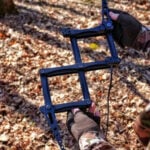
  • Limb Legs are Essential: Use “limb legs”  or a similar product to keep your bow standing upright in front of you. This minimizes the movement needed to get ready when the bird is in close.

4. Time Your Draw

The hardest part of this hunt is getting to full draw undetected. You have to wait for the bird to give you the green light.

  • Let Him Commit: Don’t rush. Wait for the bird to enter your decoy spread and go into a full strut.
  • The Blind Spot: Use the bird’s anatomy against him. When his tail fan is up and his back is to you, he is effectively blind to your position. That is your best window to draw.
Ditch The Blind: 5 Strategies For The Ultimate Eye Level Challenge
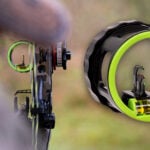
Go for a large diameter mechanical head. With such a small target, bigger is better.

5. Tactical Shot Placement and Gear

After all the hard work, you need to make the shot count.

  • Mouth Calls Only: Throw away the pot calls once the bird is in sight. You need to be hands-free. A simple yelp or “putt” from a mouth call can stop a walking bird exactly where you need him.
  • Go Big on Broadheads: Utilize a large, expandable broadhead. The massive cutting diameter provides a much-needed margin for error on a bird that is a constantly moving small target.
  • The Sweet Spot: On a broadside bird, aim straight up the leg and in line with the base of the beard. Where those lines meet (the wing joint) is the heart and lung zone.

Final Thoughts

Bowhunting turkeys without a blind can be the most frustrating experience of your spring, but it is undoubtedly the most rewarding. It forces you to be a better woodsman and a more disciplined archer. 

Even if you don’t fire an arrow, the lessons you learn being three feet away from a spitting, drumming gobbler will stay with you forever. Give it a try this spring—just be prepared for the ultimate rush.

Success
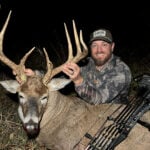
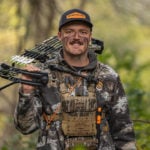
The Author after a successful blindless hunt.
Kurt Thorsen
Kurt is a Wildlife Habitat Manager that graduated from UW-Stevens Point with a Bachelor's Degree in Wildlife Ecology, Research, and Management. He's a die-hard outdoorsman from Northwestern Illinois that's extremely passionate about chasing deer, turkeys, ducks, and sushi rolls!
    View 1 Comment
    Post a Comment

    Your email address will not be published. Required fields are marked *