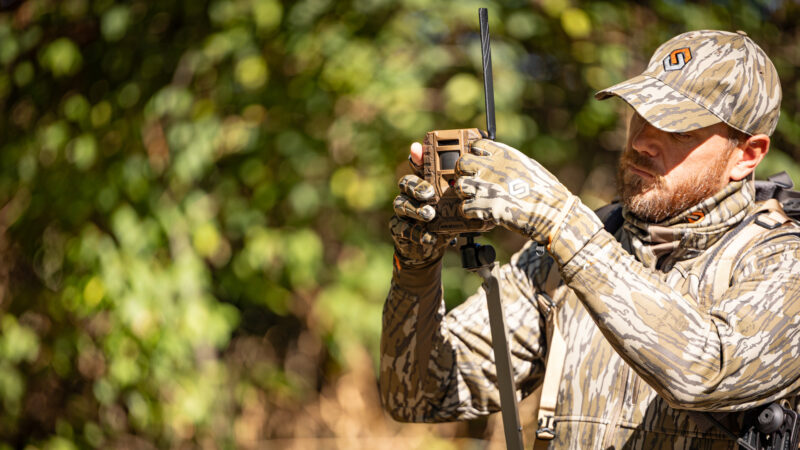
Let’s be real. Modern cellular trail cameras play a huge role in our daily lives as a hunters. Watching football and trail camera photos roll in? You’ll be checking pictures.
If the baby wakes up in the middle of the night and you get a transmission of photos – don’t lie, you’ll be scrolling for your target buck. It’s the fear of missing out and the addiction of seeing bucks in the palm of your hand.
Most of your trail cameras are probably out by now, but you might want to shift a few to get ready for the peak rut. Here is where to put your trail cameras in the month of November.
Don’t Overthink It
Before I dive headfirst into specific locations of where to place your trail cameras, I’ll start with some general advice – don’t overthink this!
One of the biggest things I notice with hunters running trail cameras is the placement of cameras in unusual spots, often with the belief that older deer don’t travel in the same locations as does and younger bucks.
This may be true to a certain extent, but older bucks (if that’s your goal) will travel near edge cover, hit scrapes, and use food plots just like other deer. Don’t overanalyze this, especially if you’re placing cameras on a new property.
Scrapes and Licking Branches
If I could only put trail cameras in one spot for the rest of my life, it would be on scrapes. A well-placed mock scrape will get a photo of every deer in the area, and bucks will continue to hit the scrape, giving you insight into where they travel to and from, and at what time.
The best part about a scrape is that they can be made and placed anywhere. A mock scrape rubbing post combination can be placed anywhere and serve as a huge communication hub.
Or, cut down an 8-10’ tall sapling and wire tie it to a T-post you’ve pounded into the ground 20 yards from your stand in a food plot. Scrapes are a power tool to coax deer into shooting range with archery equipment, and you need to have trail cameras near them for the rut.
Doe Bedding Areas
Placing trail cameras in a doe bedding area can be frustrating due to repeated pictures of does and fawns – until the rut kicks in. I have a location that rarely captures a mature buck photo until the rut.
Resident does are responsible for eating up my cellular data usage until late October rolls around.
Once the pre-rut starts kicking though, photos of bucks tearing up the mock licking branch I have buried in this ridge point doe bedding area will start to roll in. The area stays hot for the next two months, as does come in and out of estrus during the first and second rut.
During the month of November, you need to stay informed of where and when does and bucks are moving through key bedding locations. Stick a solar panel on bedding area cameras and stay out.
You’ll need this critical information that the camera provides. Their movements will tell you how to access these spots and when to dive in and hunt.
Funnels and Travel Corridors
For hunting, I rely on rut funnels and travel corridors during the rut. I also place a good number of cameras on them. A funnel on one property may look completely different from another.
Funnels are created when deer can’t travel anywhere else. Funnels, pinches, and other travel routes should be key locations for your November trail cameras.
Throughout your spring and summer scouting, drop pins and map out these locations you think will get hot during the rut. In hill country, saddles, steep ridge points and trails below rock outcroppings and other impassable terrain not only make for a great trail camera location but a good spot for a treestand.
In flatter territory, place cameras where differing habitat meets. Pines meeting crop fields or hardwoods will attract deer. If water is present on the property, find edges where deer funnel through and walk alongside ponds.
In western states, you might rely on deer bedding 3/4 of the way up a small draw or canyon and then have to place cameras at the bottom where a few crossings exist. Any sort of standing water in the arid plains will attract animals as well.
Near flowing water, look for bends or areas where the river bank isn’t as steep, where deer will cross. The best part about creek crossings is that deer rarely notice the camera because they are busy navigating through the water and up to the riverbank.
Travel corridors around food require you to backtrack a bit. If you know where deer end up spending time once they are in a bedding area, walk those trails out to the destination crop fields or food plots and place your camera along those routes.
Routes to and from food and bedding areas are the key rut camera locations you should key in on.
Field Edges
Field edges close to bedding areas when the crops are still standing make for great trail camera locations during the rut.
Nervous does that are in estrus will take advantage of thermals and hang inside the woods for a few minutes before stepping out at last light, but her temporary boyfriend might be close behind.
Field edge corners tucked away from road noise and human traffic are the best edges to hunt and place trail cameras because of the lack of human noise and intrusion.
My favorite scenario is placing the camera over a mock scrape where the farmer turned to start planting a different direction, right on the corner where the field turns. These areas see heavy deer traffic in years of standing corn.
Ridge Tops
I’ve mentioned ridges a few times here, but there are specific runways on a ridge that are better suited for trail cameras than others. I do get photos of deer using the highest point on a ridge, but I get more photos of deer using trails 1/3 of the way down off the ridge on the leeward, “military crest”, of the ridge.
Deer walking trails on the military crest can use a wind advantage to smell danger on top of the ridge and can look down into a valley or ditch to view danger. Now, this isn’t to say mature deer will never use the highest point on a ridge, but they do expose themselves to more danger doing this. Personally, I run cameras on both.
Another amazing ridge top feature is a saddle. A saddle is essentially a low area and natural crossing between two high points. Deer will use these to run up and down the points or travel perpendicular.
Locations where a ridge turns or “doglegs” a certain direction can be a spectacular travel route for deer and make good spots for a trail camera. Areas like this will be used heavily during the rut.
Best Trail Camera Settings
My best advice for running trail cameras during the rut is to run a short photo delay and consider turning video mode on for your best cameras. Since mainly bucks trail behind does during the rut, running any delay longer than 15 seconds runs you the risk of missing a trailing buck.
I usually run the shortest delay possible on cameras near my best stands during the rut.
Some cellular brands allow burst mode, but only transmit the first photo and save the subsequent photos to the SD card. For most intel, video mode is the way to go. Body language, deer behavior, and postures all come to life. You can pay extra data to have videos transmitted, or enable video to save to the SD card, but only have your camera transmit the photos.
Final Thoughts
Building up years of trail camera photos, videos and data not only helps you better prepare for deer season, but gives you an edge on when and where to make your move throughout the month of November.
What about you? What are your favorite places to hang a trail camera during the rut?
Comment below, and let us know what you think.