Few things get the blood flowing deep inside the bones of a whitetail hunter quite like seeing a freshly opened scrape. Every year, hunters debate the location, timing, meaning, and importance of natural and mock scrapes.
When creating a mock scrape, there is no single way to do it successfully. But there are wrong ways to do it. Hanging a random rope, vine, or branch too high in an odd location and crossing your fingers that your target buck drops by for a photo or shot opportunity, isn’t the right approach.
Here is how to find the best locations and influence deer movement to optimize your scrape setup for trail camera photos and shot opportunities.
The Role of Scrapes
Whitetail deer nuzzle and lick overhanging branches to leave scent and communicate their dominance and presence to other deer in the area. Deer lick and leave scent on overhanging branches all year long, but bucks don’t tend to paw the ground below until after velvet shed, when testosterone begins to rise.
Overhanging branches are a key component of communication in a whitetail scrape. Deer can paw the ground just about anywhere, but without a branch, vine, or rope, the “stick out like a sore thumb” aspect of a scrape diminishes greatly.
If you haven’t created a mock scrape in some of your key locations yet, it isn’t too late. I tend to work on fixing or hanging new mock scrapes during my spring scouting trips, and deer use them just a few hours after I leave. Although it is better to start earlier, allowing more scent to accumulate in the area, it’s not too late.
Location is Critical
First, if you’re hanging a mock scrape, you need to determine whether you expect to hunt near the scrape or just hang a trail camera over it for inventory.
Mock scrape sites can be a key communication hub for all deer in the area, but they won’t provide any value if they are hung in poor locations or hung too high. A well-placed mock scrape will enhance an already high-traffic deer area, but don’t think you can just bend a branch or hang a vine anywhere and expect deer to find it and use it. It takes a plan.
The intersections of mowed trails, logging roads, food plot edges, and crop field corners make for excellent mock scrape locations. I’ve found that deer prefer a relatively flat location, with room to move and rotate their body around the scrape as they work the overhanging branch.
For large fields or food plots where defined travel is hard to pin down, cutting down an 8-10ft sapling and wire-tying it to a T-post is a sure-fire way to get deer to visit a specific area near your stand. Bend the branches over, clear the ground, and go hunting.
However, randomly bending over a branch in the middle of the woods and clearing the ground around a tree near your stand may not work. The ground may be uneven, and it could be a spot where deer just aren’t interested in moving through. It needs to be an area where deer want to be. Staging areas just inside the woods, and transition zones from bedding areas to feeding areas, can work well. High-traffic intersections of trails are a good option as well.
When you find the perfect location, weed trim existing vegetation in a 10’x10’ area by your mock scrape to create room for socialization and movement of deer near the area.
Then, use a rake or weed trimmer to trim to the dirt in a 4-5’ circle directly underneath the branch, vine, or rope. You want the scrape to be extremely obvious so deer find it right away. Deer will also be attracted to the fresh smell of trimmed weeds and freshly exposed dirt.
Height and the Importance of the Branch
A great location and freshly exposed dirt are null and void unless you’ve hung your branch, vine or rope at the right height. I find the best height to be at my belly button (I’m 6’ tall), give or take a few inches. Many hunters underestimate how short deer are when hanging mock scrapes, or even trail cameras for that matter.
If deer cannot reach the overhanging branch or have difficulty doing so, your scrape might not see heavy deer traffic like it should. Deer will go on their hind legs to reach the branch, but your scrape will be used more when deer can easily reach it.
The choice of using a rope, vine, or natural branch comes down to availability and finding what works best in your area. I tend to use vines and branches, in that order. But, they all work well when placed in a good location and at the proper height. Don’t get too hung up on what to use, but focus on location and height.
When using a vine, I drill a hole through the top of the vine and run both paracord and a ziptie through it. Then, I attach it to a branch above the ground. I’ve found drilling a hole through the vine is the best way to hang them, so they don’t fall.
I’ve hammered this home already, but the presence of the overhanging branch is critical. I’ve had mock scrapes completely diminish due to a branch falling off. The branch, vine, or rope needs to be present for deer to use the scrape.

Timing
If you hang your mock licking branches in late spring or early summer, deer are probably used to hitting them by now. If you’re hanging your mock scrapes in October, you still have time for deer to find them, but you’ll want to make the scrape more obvious.
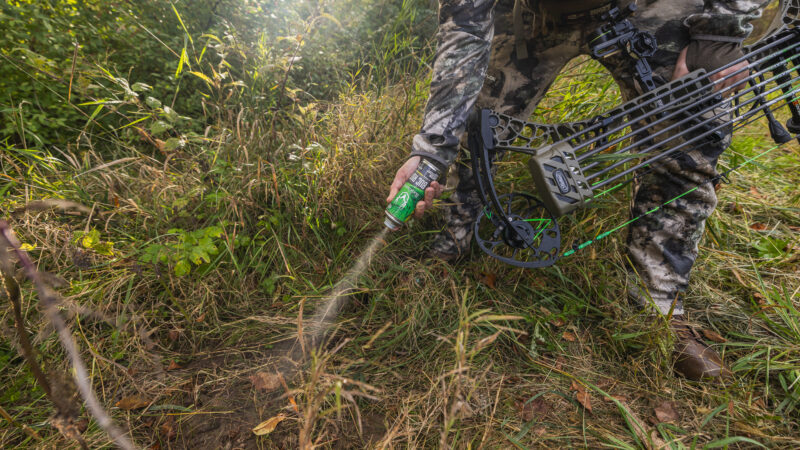
Clear the ground really well, and since you’re hanging it during the season, I would encourage using a little urine scent in the dirt or preorbital scent on the branches so there is no delay in deer finding and using the scrape.
Last-minute scrapes can work too. If you’re headed into one of your favorite stands and it’s already peak rut, bend over a few overhanging branches, and clear the ground before climbing up into your tree. Something as easy as that could entice a buck to stop by.
Should You Use Scent?
The truth is, you don’t need scent to get a scrape started. But if you ask a hundred different hunters what scent to use on a mock scrape, or if they use scent at all, you very well might get a hundred different answers.
If you make your scrape obvious and enough deer visit your mock scrape, there is no reason to use scent or re-visit the scrape. Hang a camera on the scrape, and stay out; deer will flood the area with their own scent. I think you’re doing more damage by visiting a scrape to add scent. I count on the deer adding scent for me. But if it gives you confidence, go in as scent-free as possible to place scent.
Wrapping Up
Mock scrapes are a simple and effective tool to bring deer into range. It takes a little planning, some common sense, and following a few guidelines I’ve laid out in this article. Unlike many projects in the modern hunting world, the cost is cheap, and labor isn’t intensive.
Comment below, and let us know what works best for you when building mock scrapes.