I’ve hunted for several decades now and have learned many lessons in the whitetail woods. The first realization that many new hunters often come to is, “You just don’t go sit in a tree and kill a buck.”
While hunting outsiders may see it this way, experienced hunters know this to not be true. There is so much that goes into a successful hunt. Prior scouting, good weather, and time of year all contribute to having a good hunt. But I would argue that most hunters are consistently messing up the most important determinant of having a good hunt – treestand access.
I’ve seen novice hunters, and experienced hunters alike, fail in this area. I still fail in this area from time to time, but if you start making an intentional effort to have good stand access, there is no doubt that your deer sightings and hunt success will improve.
For years, I didn’t even realize my stand access was bad. I basically checked two boxes and assumed that my access was good. Did I alert any deer walking to my stand, and was my on-stand wind good?
These were the two questions I asked myself and based the quality of my access on. I didn’t realize I was doing unseen damage and educating deer. We were killing a few bucks here and there on our property, but we weren’t killing the more mature bucks, and our trail camera pictures were sporadic.
It wasn’t until six or seven seasons ago that I realized my access was a problem. After consuming many hours of whitetail hunting content and reading article after article, I realized that I wasn’t putting enough thought into my stand access. There are layers to this, and when I started to put more emphasis on it, I started seeing and harvesting more bucks.
Good stand access has multiple factors that contribute to it, and it can get complicated if you overthink it. I like to simplify the process, breaking it down in terms of the deer’s perception and ask myself three simple questions.
Am I Avoiding the Deer's Eyes?
There is no doubt that if a mature whitetail buck sees you, it’s game over. They may not appear to make a big deal of it, but they have already decided to keep their distance.
That’s why staying out of his line of sight on the way to the stand is just as important as staying out of sight while sitting in the stand. While it’s true this is harder to pull off on some properties than others, there are still things you can do to avoid a deer’s eyes.
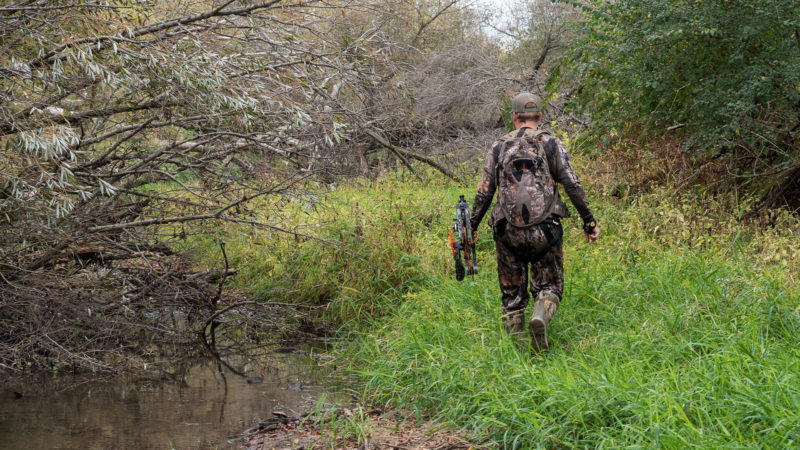
Start by avoiding any open field walking, especially if it borders a bedding area. I always like to use the natural brush or tree lines to break up my outline. I also like using topography and terrain to my advantage.
Practices like staying below the ridgeline or dropping down into the creek bottom can keep you out of eye sight. Avoiding the deer’s sight usually requires that you use the harder path or take the longer way around, but I promise it’s worth it.

Am I Avoiding His Ears?
While deer don’t depend on their ears as much as their eyes, they are still a vital piece of their defense mechanism. If you’ve hunted for a while, you know that it doesn’t take much foreign noise for a deer to key in on a sound.
This is especially true for sharp, clanging noises like when metal clangs together. Just as a buck does when he sees a threat, hearing a threat will often cause him to stay in his bed or find a different route to his destination.
Luckily for us, this a fairly easy solve. First and foremost, slowing and quieting your step cuts down on the overall volume and therefore carry of your sound. I also like to change up my gait pattern as I get closer to the stand.
I take frequent rests to give the woods time to calm down again. This mimics the natural walking pattern of other animals as well. I also make sure that any loose equipment is cinched tight to my pack. Dangling gear is loud gear.

Am I Avoiding His Nose?
This is where access can get even trickier. A buck’s nose is undoubtedly his most powerful tool. He uses it to consistently get himself out of trouble and into pleasure.
It’s easier to visualize how to avoid a deer’s eyes and ears, but it’s hard to visualize how scent travels. Swirling winds and changing thermals only add to the challenge and give deer the advantage.
Always pay attention to wind direction when approaching your stand. Ensuring that you are down wind of your setup and any bedding areas, can ensure success. Using different wind direction tools like powder or milkweed can be beneficial, along with any other digital wind director apps.
Staying downwind may require you to take the long way around to ensure your wind cone isn’t affecting any deer, but as with the other previously mentioned points, it’s well worth it.
I stand firm on my statement that good stand access is the number one indicator for hunt success. Most of the time, what you see while sitting on the stand is determined by your actions and discipline while approaching the stand.
Good access isn’t always easy or available. There is a level of discipline and hard work that is needed to ensure good stand access practices. It is something you have to study and put time towards. We never just waltz into good access; you have to develop it.
If you take the time to avoid the deer’s eyes, ears, and nose, your success and enjoyment while hunting will only increase. I’ve been there and seen both sides of the coin, and today, I side with great access.
Final Thoughts
Are you avoiding his eyes? Are you avoiding his ears? And are you avoiding his nose?
If you can confidently say yes to all three of these questions, you have good stand access. If you can’t, you have some work that needs to be done.
Just keep in mind, if you don’t have good access, you’ll struggle with success, regardless of how good the spot looks. Access is easily the #1 key to success each season.