If Ed Durkin had worn a GPS unit the past 25 years, anyone monitoring his whereabouts could have predicted he would die one day within yards of his garden or orchard on Lake Poygan’s southern shores in central Wisconsin.
And so he did on Friday, Oct. 27, at age 88 after covering his garlic plants with straw to protect them from the coming winter.
Although Dad taught me to hunt, fish and shoot as a boy, he never embraced all the waiting – the “dead hours” — of hunting and fishing. He preferred the predictable harvests of his fruits and vegetables over the uncertain crops of nature’s fillets, backstraps and hindquarters.
Hunters and anglers, after all, can’t dictate the movements and feeding patterns of fish and wildlife. Dad, though, could plan each year around the preferred times for roto-tilling and planting; weeding and watering; and pruning, spraying and harvesting.
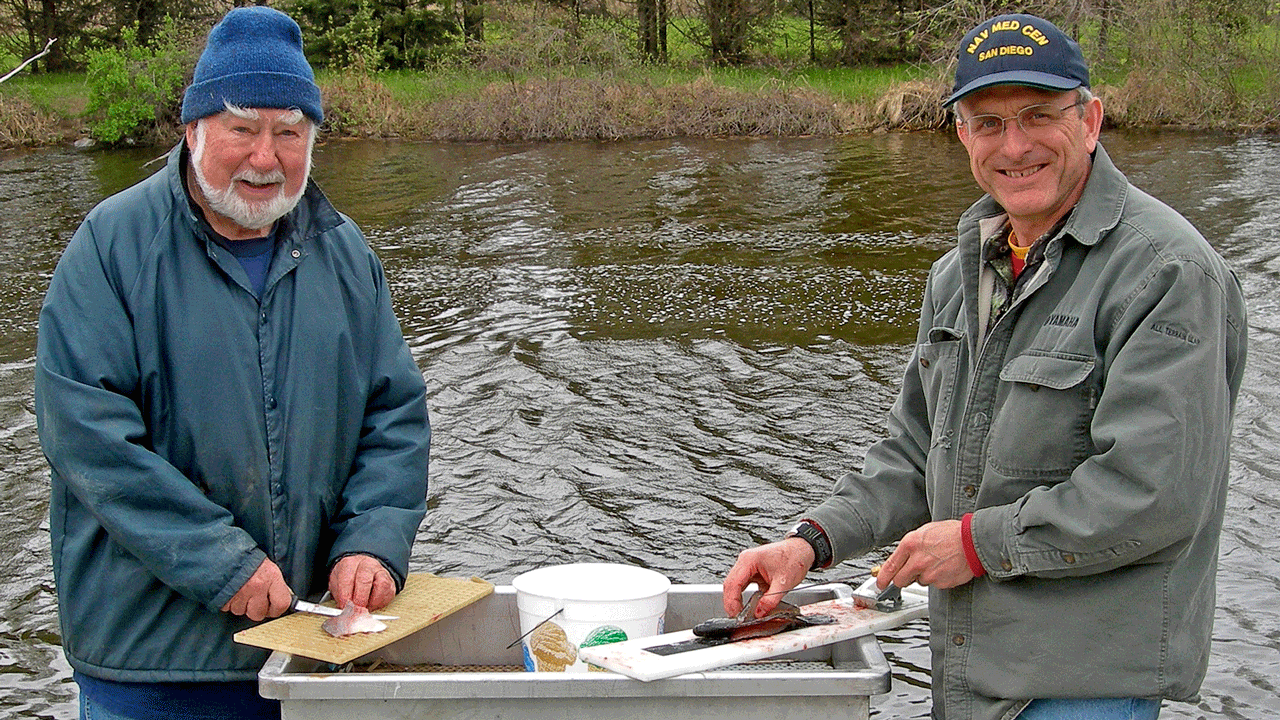
Ed Durkin, left, and his son Patrick often filleted fish caught by their family members.
Maybe you’ve read John F. Kennedy’s advice on productivity: “We must use time as a tool, not as a couch.” If I were a serial liar, I’d accuse JFK of stealing my father’s motto. Dad seldom watched TV, rarely read fiction, and forever sought the shortest routes from Point A to Point B.
During his retirement, Dad rose early each day at prime times to hunt or fish, but usually went straight into town for coffee, breakfast and a newspaper before launching a “project” back home. Those labors usually involved his pear, plum, apple, cherry or apricot trees; or his beets, parsnips, lettuce, carrots, tomatoes, raspberries, strawberries and other garden plants.
Make no mistake: Dad’s preferences were more about impatience than pessimism. You’ll never know a more optimistic gardener. He planted English walnut trees at the northern frontier of their range, and nurtured them to about one good crop per decade. He also transplanted Florida-born kiwi vines at Poygan, and then kept them on life support until they pulled the plug themselves rather than endure another Wisconsin winter.
Despite his preference for gardening, Dad knew enough about hunting and fishing to teach kids and grandkids the basics. He also kept everyone equipped with bait, bullets, arrows and fishing tackle when they visited Poygan. You just couldn’t expect him to fish long beside you in the property’s surrounding channel. After 10 minutes without a bite, Dad often stuck the rod’s butt into one of the 2-inch pipes he hammered into the bank, and said, “Watch my line.” He’d then return to his crops.
But when Mom and his grandkids caught crappies and bluegills, Dad always pitched in to skin and fillet the fish with me. Cleaning one’s harvest, after all, is time well spent.
I recognized Dad’s patterns and practices at Poygan from my childhood in the 1960s. Dad taught me to tie a fisherman’s blood-knot at age 8 and to shoot a .22 rifle at age 9. He left the archery instructions to one of my uncles about the same time. Soon after, he took my brothers and me hunting for rabbits and squirrels.
He also took our family fishing in Canada and northern Wisconsin four straight summers from 1968 through 1971. And he often took us fishing on the nearby lakes, and always helped me clean our catches, however large or meager.
Those outings started dwindling about the time Dad took me and my three brothers golfing one day, and said on the way home: “What I like about golfing is that we always come home with a par or two, a few bogeys, and even a birdie on good days. We never come home empty-handed.”

Dawn breaks on the Lake Poygan channel where Ed Durkin fished and gardened since 1977.
Dad probably noticed my puzzled silence. Even if he didn’t, he tried hard to keep me hunting and fishing. When I disappeared after dinner to hike down to Lake Mendota with my two-man rubber raft from Navy surplus, Dad often picked me up at dark at Spring Harbor to haul me home with my gear, along with my perch, crappies or bluegills.
He also helped hone my hunting and fishing skills by introducing me to his fellow Madison firefighters, who took me deer hunting in November and ice-fishing in winter. Dad never liked ice-fishing, but I often wondered why he didn’t keep hunting. As a grade-schooler, I watched him shoot squirrels with amazing off-hand accuracy I’ve yet to match.
Not until I turned 17 and arrowed my first whitetail did I learn why Dad had quit deer hunting years before. Even then, I had to read between the lines. After parking in our driveway and summoning him, I stood with pride next to the doe strapped atop the family’s red station-wagon. Dad smiled, congratulated me, studied the doe and said quietly, “Deer have such pretty eyelashes, don’t they?”
That wasn’t what I expected to hear, but it wasn’t disapproval. After all, two years earlier he had persuaded two fellow firefighters, Charlie Merkle and Kermit Hermanson, to take me deer hunting on opening weekend of the November 1971 gun season at Hermanson’s shack in Wisconsin’s Northwoods.
I had never before hunted deer with a gun, and so Dad drove me to Sears to buy a butane hand-warmer and blaze-orange hat and mittens. The next morning he dropped me on Merkle’s doorstep, and three nights later drove five hours to Star Lake to retrieve me.
A season or two later, Dad spotted a classified newspaper ad for a Savage Model 99 lever-action .308 rifle for $100, and summoned me to his captain’s office at Madison’s No. 7 fire station. He handed me one $10 and four $20 bills and said, “Offer $80 and settle for $90,” and directed me to the seller’s apartment.
When I returned an hour later with my deer rifle, Dad asked how much I paid.
“I gave him your $90, plus $10 of my own,” I replied.
Dad smirked and said, “I figured you’d do that.”
His certainty about my poor bargaining skills was the one thing Dad could confidently predict about hunting and fishing.
Me? I’m certain I’ll forever picture Dad cutting asparagus and rototilling clay near Poygan’s shores. And I’m even more certain I’ll forever wish he were still cleaning rabbits and filleting fish by my side.