Last fall, I hunted Kansas public land for the first time since its statewide trail camera ban took effect.
It was the most refreshing public land whitetail hunt I’ve had in years.
For the first time in a decade, I wasn’t ducking and dodging lenses. I was free to pee in relative peace, not worrying about photos being leaked on some random Facebook Group.
The Kansas trail camera ban forced me, and everyone else, to hunt “old school” again. It leveled the playing field and restored a sense of woodsmanship that technology has slowly eroded away.
The Hawkeye State is the latest in a rapidly growing list of states to remove trail cameras from public land deer hunting.
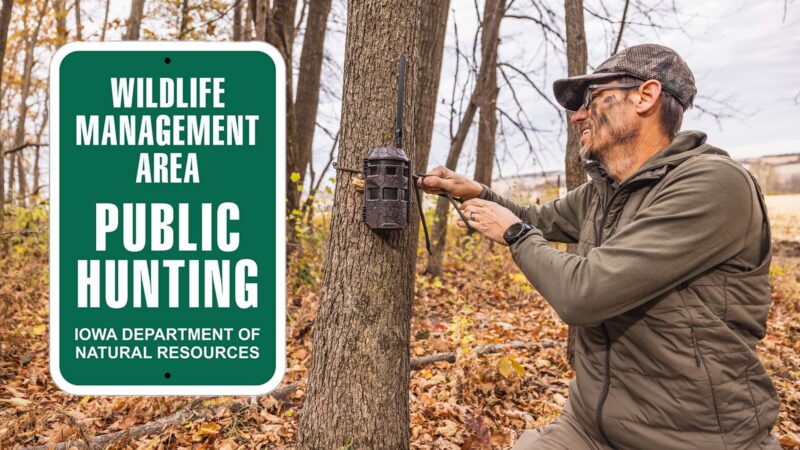
This week, the Iowa Natural Resource Commission (NRC) has officially approved a rule that has banned all trail cameras on state game management areas, effective February 1, 2027.
According to the NRC, the explosion in cameras on public land has generated a wave of complaints about conflicts with hunters, theft, and an unfair technological advantage.
After the initial proposal was announced, the NRC opened up a July meeting to public comment before making their final decision. There were a total of 102 public comments made, with 59 of them being in support of the ban.
Did You Know: Cellular Cams Are Already Illegal While Hunting
“I cannot use a phone or anything else, a camera, that is actively communicating to me while I’m hunting. And so cellular cameras are not legal currently anywhere, private or public land [while actively hunting].”
For me, the most interesting takeaway from the DNR’s recent briefings isn’t just the public land ban, it’s how the state currently views cellular trail cameras across all land, including private property.
Many states, including Iowa, have long had laws on the books prohibiting the use of communication devices to aid in taking game.
- The 1970s: The original law was written to stop groups of hunters from using CB and two-way radios to herd or drive deer across fields. First, the 55 mph speed limit, and then this? Surely it was a sign of things to come!
- The 1990s: The language was updated to include cell phones, making it technically illegal to text your buddy on the other side of the farm to tell him a giant buck is heading his way. But you can still tell him you love him and cherish his friendship.
Now, the Iowa DNR has explicitly extended that interpretation to cover cellular trail cameras if you are actively in the woods.
Earlier in the year, when the ban was only proposed, Iowa DNR Wildlife Research Unit Leader Chris Ensminger pointed out, “I cannot use a phone or anything else, a camera, that is actively communicating to me while I’m hunting. And so cellular cameras are not legal currently anywhere, private or public land [while actively hunting].”
Ensminger continued, “There is no current restriction on regular trail cameras, a card-based trail cameras on public lands.”
The reality: If you are sitting in your treestand, your phone buzzes with a cellular trail cam photo of your target buck crossing a ridge 200 yards away, and you grab your rattling antlers to call him in, you are technically breaking Iowa law.
But if you wake up from a long night’s slumber and check your favorite trail camera app to find a photo of your target buck working a scrape, then head out to hunt that deer, you’re in the clear.
Make sense to you? Me either.
Not Just Cellular Cameras
While cellular cameras are already “restricted” during active hunting hours, this new regulation also targets traditional, card-based cameras on public land. Up until now, there have been zero restrictions on traditional cameras where you physically walk in, pull the SD card, and check the images at home.
People still use those?
It’s Not Only Iowa
Iowa has now joined a large bloc of Western and Midwestern states, including Kansas, Utah, Nevada, Arizona, and Colorado, that have heavily restricted or entirely prohibited cameras on public lands.
And with the current winds blowing in a certain direction, I anticipate more states to join this list in the coming years.
| STATE | PUBLIC LAND STATUS | CAMERA RESTRICTIONS |
Iowa | Banned | Total ban on all public lands |
Kansas | Banned | Full ban on state game management areas |
Utah | Banned | Full seasonal ban on all trail cameras (public and private) from Aug-Dec |
Arizona | Banned | Total ban on all trail cameras for the purpose of hunting |
Conflicted Yet Optimistic
As someone who has spent over thirty years in the bowhunting community, my initial reaction to any new hunting restriction is deep skepticism.
If you’ve ever tuned into an episode of the Watering Hole podcast, you’ve likely heard me rant about worthless hunting regulations and our inept government overstepping its boundaries.
Why are bow case laws a thing??
I value small government and strongly believe that the less bureaucratic intervention we have in our lives, the better.
But I am also a realist. And the truth we have to face is simple: we have failed to police ourselves.
Go back a decade; finding a trail camera on public land was a rarity. Today, you spend more time dodging cameras than you do looking for deer sign.
I’ve watched public lands quickly transform into surveillance grids, cameras strapped every 200 yards around the edge of a state-managed bean field, or hung on just about every single usable scrape down a Kansas fence row.
At some point, enough is enough.
Public Land Isn’t Just For Hunters
There is an even broader angle here that we, as hunters, frequently ignore. Public land belongs to the public, not just those of us looking to fill a tag.
When a family goes hiking, a birdwatcher sets up a tripod, or a couple goes camping on state-managed ground, should they have to worry about their privacy? Is it fair for a non-hunter to walk a public trail and constantly have their photo captured by anonymous cameras hidden in the brush?
When we overwhelm public tracts with cameras, we aren’t just frustrating fellow hunters, we are alienating the very public whose tax dollars help maintain those spaces.
So while I remain inherently skeptical of state overreach (I hate the government) and impossible-to-enforce laws, I find myself torn on this topic.
I get it. The Iowa DNR’s proposal is a bitter pill to swallow for those who rely on cameras to maximize limited scouting time and target specific, mature deer. This is especially hurtful to public-land hunters who don’t have private spots to fall back on.
But then again, this regulation might just save us from ourselves, and return the “hunt” back to public land.
What Do the Insiders Think?
Banning trail cameras on public land remains one of the most polarizing topics in the modern outdoor space. At the 2026 Iowa Deer Classic, we walked the floor to ask top industry insiders, land managers, and die-hard public land bowhunters exactly where they stand on the issue.

What Do You Think?
I know a lot of you out there are going to disagree with me, and that’s fine. It’s okay to be wrong. So if you’ve got an opinion on using trail cameras on public lands, drop it below!
And if you’ve gotten a pic of me going #2 in the woods somewhere along the line, please delete it. Nobody wants to see that.