LAST UPDATED: May 1st, 2015
Ground blinds serve many useful purposes, from allowing setting up in areas where stand trees are completely absent, to quelling the acrophobe’s fears of heights, to making bowhunting turkey almost too easy. Blinds can also be used to share hunts with a fidgety child or loved one, cut a chilling wind during frigid late seasons or contain scent at a difficult whitetail site. The modern pop-up blind provides instant concealment in a wide variety of situations, from the edge of a whitetail’s corn field to the elk’s mountain waterhole, while an old-fashioned brush blind is just as viable today as it was in Fred Bear’s day. Getting the most out of hunting blinds includes a few basic ground rules, but certainly isn’t the handicap many believe. Here’s how to proceed.
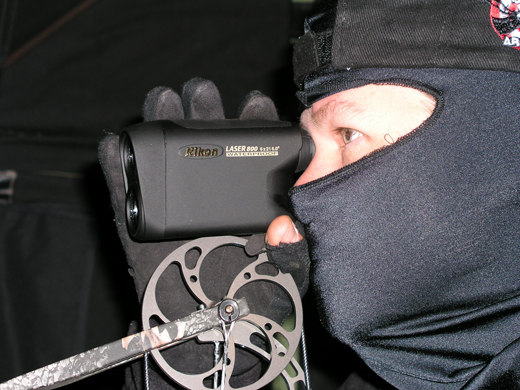
Ground Blinds offer a dark environment for bowhunters, allowing them to not only move about more freely, be also be successful when treestands are not an option.
Wide Open Bowhunting
Over the years I’ve been faced with many situations where a viable stand tree just wasn’t available. In Western Oklahoma most recently, on Colorado’s Eastern Plains, at the edge of Kansas food plots, in Texas’ thorn and prickly-pear scrub and Nebraska river bottoms with jungle-thick cover but no trees big enough to support a stand.
Wide-open areas have long remained off limits to stand hunters. The pop-up has opened an entire world of habitat to bowhunters. Obviously, a blind is meant to disguise our presence, but the sudden appearance of a pop-up isn’t likely to go unnoticed by savvy deer. Still, on open fields of cut or plowed ground, on low crops such as alfalfa, clover or soybeans, placing a glaringly-obvious blind in the middle of open ground doesn’t seem to bother deer significantly. I guess the blind’s so obviously plain to see it poses no threat, added to the fact they are used to the appearance of farm equipment in such settings. Open fields are also ideal places for blinds made to feign round bales of hay or alfalfa. These are the easiest set-ups possible – pop it up, stake it and leave it. No brushing required.
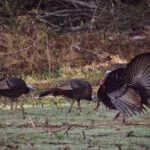
Of course, in turkey hunting placing your blind in the wide open is just as effective as one heavily brushed.
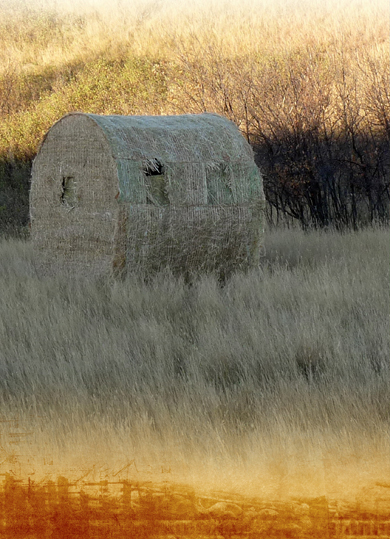
Bale blinds, available from several companies, are perfect
for agricultural settings where they look right at home.
Scent Management
In whitetail hunting scent management is everything. Many bowhunters are surprised to learn getting low is sometimes better than climbing higher in this regard. In fact, a ground blind can turn places where a stand offers little chance of controlling scent into an instant hotspot – those bottoms and benches and saddles where wind turns unpredictably to every point of the compass. Here’s what I’ve discovered. In low-laying areas where winds swirl and eddy to give deer your scent, digging in with a pop-up can actually seal your scent inside the blind. Where I live in Idaho we’re faced with this situation regularly. Low-laying meadows, hillside spring seeps and agricultural field edges where a stand will give you away every time but a dug-in blind makes you deadly. When I say dug in I mean that literally, scratching the dimensions of your blind and setting it aside before setting to with pick and shovel. Depending on soil type (hard or soft) and topography I might dig down to the level of the shooting ports or just a foot deep, setting the blind in afterwards and backfilling it to seal scent in.
Despite the fact that ground blinds can trap and hold odor, a good scent control plan should be followed nontheless.
This works best with blind models including zip-in floors, or at least skirting that backfill clamps tight. This also creates a lower blind profile that’s easier to brush over convincingly with scathed grass, brush or cut boughs. To make this approach work best you should close as many windows as possible, effectively sealing scent inside where it cannot reach an approaching deer’s nose.The approach works best after backing into a clump of willow or other dog-hair brush, leaving a single shooting port open to cover a meadow, farm field or water.
Safety First
My wife’s afraid to death of heights.This means in order for her to enjoy bowhunting I regularly place pop-up blinds directly beneath ideal stand trees. I also have a couple elderly friends who are perfectly happy to climb into a stand but probably shouldn’t. Also, for you regular monkeys out there, also consider that when late season temperatures turn brutal a pop-up is the warmest seat in the house; cutting wind, containing heat (along with scent) to keep you in the game longer. Another late-season advantage is a light blanket of snow helps blinds melt into any landscape. A word of caution though, too much snow and your blind will collapse, shattering poles and ripping walls (Blue River Innovations — 785-562-8386 – makes an adjustable-height brace and roof cup to prevent such mishap).
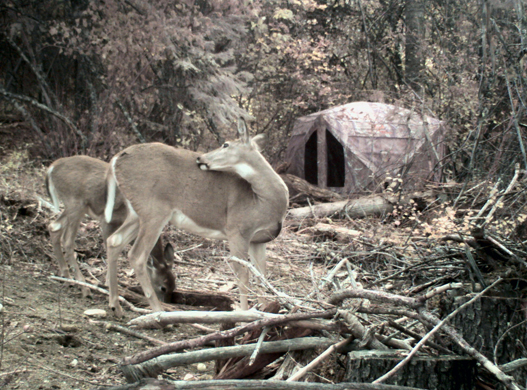
Once they have been in place for awhile, deer accept pop-up
ground blinds as a natural part of the landscape.
Unlike open fields, woodlands, riparian habitat or high grass require blending, as changes in such settings are quickly noticed and put deer on edge. In such areas I start with a leafy-covered blind before brushing them over to help them blend better. Understand though, it’s important to avoid creating an obvious “brush pile.” Best case scenario in such habitat is setting up well ahead of season, though with more care it’s possible to set up and hunt from pop-ups in thicker areas with little advanced preparation. First off, you should arrive to set up and brush your blind when deer are well removed to minimize disturbance, and go to great pains to minimize scent dispersal, wearing Scent-Lok-type clothing, clean rubber boots and gloves. Also consider setting up and brushing only when a heavy rain or snow is eminent, weather that will wash away scent after your work is done.
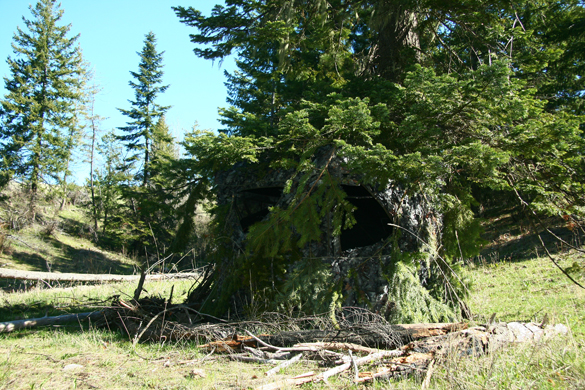
For ground blinds set up to be hunted from right away,
you’ll have to add natural vegetation to help them blend better.
One of the biggest give-aways with pop-up blinds – at least when whitetail are under discussion — are the black gaps created by shooting ports. Shoot-through screens have effectively cured this problem, for the most part, but it’s highly important to make sure your broadhead of choice will pass through such material cleanly and without affecting flight or impact. A quick backyard rehearsal should eliminate any questions. From my experience, mechanical broadheads and shoot-through screens are a bad combination.
Another helpful feature today is sewn-on loops that make it easy to attach camouflaging boughs, weeds or grass to your blind sides. I also like to place handy logs and larger branches for break-up cover, sometimes even “planting” bushes and grass clumps to help blinds become part of the landscape. Before any of this though, I start with a site that already offers plenty of backdrop cover or shade; setting up against a large blow-down, in a bank of vegetation (or corn-field edge) or beneath the umbrella of a shading tree.
Fred Bear’s Way
Modern bowhunters sometimes forget archers of old had no tree-stands or pop-up blinds available. They made their own blinds of natural materials. This has become standard operating procedure for turkeys in my “backyard” – building blinds on regularly-used strutting grounds and meadows across the 5,000 acres available to me. My best are “caves” of shadow created by brush and logs, the deep shadow acting as better camouflage than piled brush. These blinds are also great during warm early seasons when a stuffy pop-up becomes oppressively hot, and cost me nothing but a little time.
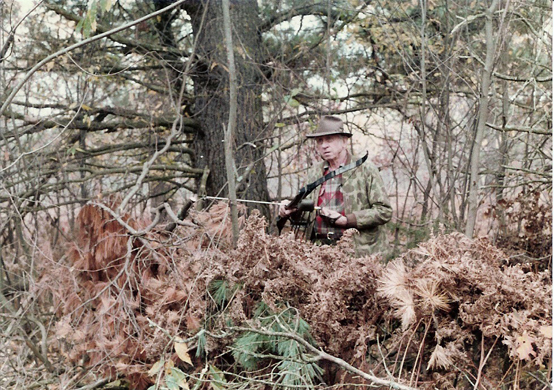
Fred Bear understood that the natural ground blind has
helped bowhunters through millennia earn close shots at game.
Natural blinds require abundant natural material; big logs to use in “Lincoln Log” fashion, long saplings or rails to wire or tie between three or four evenly-spaced trees to create a basic frame to drape other material over, or a clump of thronged brush or young trees allowing you to borrow in and clear out a spot to sit unseen. No matter the approach you’ll need to create an open space big enough to shoot from while sitting or kneeling, a “roof” to seal out daylight, and shooting ports facing likely shooting areas. Ideally the natural blind is backed by a stream or nasty briars where deer will not travel, with wind blowing into your face.
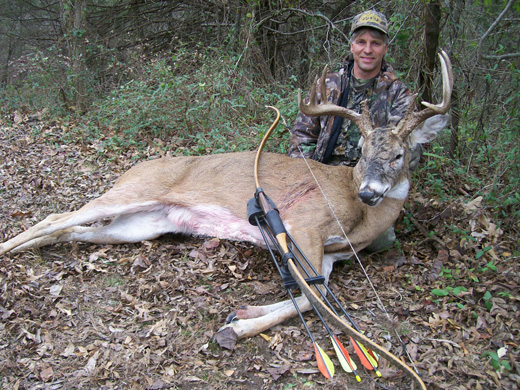
Kansas traditional bowhunter Keith Jabben shuns tree-stands, preferring to keep his feet planted firmly on the ground
while deer hunting.
I find materials such as pine or cedar boughs and bark “shingles” especially useful for roofs and sides, scattering armloads of pine straw or leaves over the works after creating an effective framework. The effective burrow blind’s a simple matter of finding tight clusters of vegetation – blueberry juniper (cedar), ground-hugging firs, tangled honeysuckle or cane, depending on region, hacking away only enough interior material to create a comfortable nest, leaving what’s needed for cover. Facing natural blinds with items such as Rancho Safari’s Shaggie Shield tent-pole-framed camo netting makes natural blinds easier — and deadly effective. Too, don’t hesitate to dig a pit blind into the floor, at minimum to hold your feet while sitting to create more headroom. A pit also helps contain scent.
There’s a reason tree-stands are popular, but there’s no arguing ground blinds still get the job done — used in places where elevated stands simply aren’t possible or by those who have a fear of heights. Ground blinds open more options according to terrain; or for whitetails that have become so used to overhead threats they walk around scanning the treetops.