Trail cameras have become a significant part of my scouting efforts each fall. They don’t take the place of in-the-field scouting and scouting from afar. But they’re a new piece of the puzzle that certainly have their place in the mix.
There are certain places that your trail cameras should be this season. Below you will find three potential locations to focus on for the four major phases of the season.

Do you have your trail cameras set up in the right places this season?
Early Season
The early season is a time to get after big bachelor groups and velvet bucks. Deer aren’t pressured yet. Their guard is down. And now is the best opportunity you’ll have all season to fill that tag, even more so than during the rut.
Food Sources: It’s all about the food. The grub is at the center of all deer activity. Hanging trail cameras over food sources is a great way to take inventory of the deer in that area. Plus, you’re less likely to pressure deer by running cameras on food sources rather than near bedding cover.

Make sure you have trail cameras at the local watering holes to take inventory in the early season.
Water Sources: This is another great early season tactic. Posting trail cameras over a well-used water source is another surefire way to survey the herd. However, it works much better during drier weather. When water is abundant, deer are more spread out and this method isn’t as effective.
Bed-to-Feed Trails: Another great option is a worn bed-to-feed trail. These are major trails deer travel on from bedding areas to food sources. Deer haven’t received much pressure this early in the season. So even mature bucks are likely to use these whitetail highways, whereas they’ll likely begin using smaller, secondary trails once hunters flock to the woods.

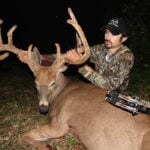
Trail cameras played a huge role in the tagging of this buck. The author monitored the deer’s activity — and the big bachelor group it ran with — for a month before killing it the opening week of the archery season. (Kathryn Honeycutt photo)
Pre-Rut
Hunters are pressuring deer now. But bucks are beginning to fall into their pre-rut routines. As their testosterone levels rise, rut sign will begin to pop up on the landscape. Take advantage of it.
Scrapes: The odds of killing a big buck directly over a scrape are minimal. Most scraping activity is conducted at night. However, recent studies show that bucks still often hang out nearby their scrapes during daylight hours. Hanging trail cameras over a scrape might only give you nighttime photos of that big buck you’re chasing. But he could be bedded just up the ridge from where it’s at.

Checking trail cameras is one of the exciting chores of the hunter that can pay off in big rewards.
Rub Lines: Heavy rub lines are indicative of a buck’s (or bucks’) travel route. Setting up a camera on one will give you an idea of what’s in the area. Remember, rubs that face bedding areas are generally made of an afternoon as a buck heads out to feed. Rubs that face away from bedding areas are typically made of a morning as a buck is heading back to cover.
Secondary Trails: Hunters are applying a good bit of pressure by now. Deer are reacting to it. Mature bucks aren’t using major trails like they were. Instead, they’re hitting smaller, secondary trails that hunters often overlook. Hang cameras here even if you don’t see a lot of tracks. You might just be pleasantly surprised.
Rut
The big dance is here. The most magical time in the world of whitetails. It’s November. And bucks are running crazy. It’s time to change up the game plan once again.
Pinch-Points: A pinch-point is where a tract of timber pinches down to a narrow point. An example is an hour glass. It’s wide at both ends but very narrow in the middle. Sand traveling through the hour glass must pass through at a very concentrated point. Deer traveling through a pinch-point is much the same.
Saddles: Steep terrain offers ridges. Oftentimes, those ridges run for some distance. But somewhere along the way they’ll sometimes briefly taper down and rise back up again. This area is defined as a saddle. Deer like to use this geographical feature to get from one side of the ridge to the other. It keeps them from exerting energy required to climb up over the top.
Hillside Benches: We sometimes see old benches — or roadbeds — along ridges. Generally, they’re between halfway and three-quarters of the way up the ridge and run the length of it horizontally. Some are man-made. Some aren’t. Regardless, bucks love to travel along them as they scent-check for does.

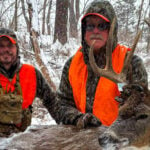
This buck proved difficult to hunt. The author received preseason and early season photos of the buck. But it was living in a small thicket away from where hunters typically hunted. The author finally caught up to the buck and killed it during the rut. He had photos of it traveling through a pinch-point all season long. (Marty Honeycutt photo)
Post-Rut
Bucks are beaten and bruised. So are hunters. It’s time for one last-ditch effort. Pull yourself up from the ground, dust off your camo britches, and let’s get to work. You’ve got deer to find.
Food Sources: You might notice I’m reverting back to early season approaches. And it’s true, the late season is much like the first phase in some ways. Most deer — with the exception of some second-rut action — are focused on filling their gut and recuperating from the rut. So focusing on quality late-season food sources is a solid bet.
Water Sources: I usually only employ this tactic if it’s very cold and water is freezing. Once it gets cold — and stays cold — many water sources lock up. Take advantage of this by finding the few remaining open water sources and hang cameras over them. You’ll see just what’s around.
Sanctuary Bedding Cover: The major difference between the early season and the late season is deer are pressured. They’ve been hunted for several months and describing them as skittish doesn’t begin to describe their state of mind. Bucks have slinked back into the thickest, nastiest, most secure sanctuary bedding cover they can find. It’s how they survive. Hanging cameras on the downwind side can give you loads of insight.
The Bowhunting.com crew uses Stealth Cam cameras for scouting before, during, and after the season. Stealth Cam offers a variety of options to meet any hunter’s needs. Check out their complete line of products at www.gsmoutdoors.com.