
Aaron Knutson enjoys late October and early November as much as any serious bowhunter, but most years this Wisconsin dairy farmer is done bowhunting before that magical time known as the rut.
That’s because Knutson, 35, of Ridgeland, Wisconsin, usually arrows his bucks by early October when they’re still in their summer feeding patterns. Still, he’s not complaining. As with most bowhunters, he loves being in the woods whenever possible to scout for deer or wait them out from a tree.
Knutson targets only bucks he estimates are 4½ years or older, and so far he’s shot nine such whitetails that qualified for the Pope & Young Club’s Bowhunting Records book. He arrowed one of those bucks in northeastern Iowa in 2008. The other eight came from the hills, marshes and woodlands he hunts near Sand Creek, Wisconsin.
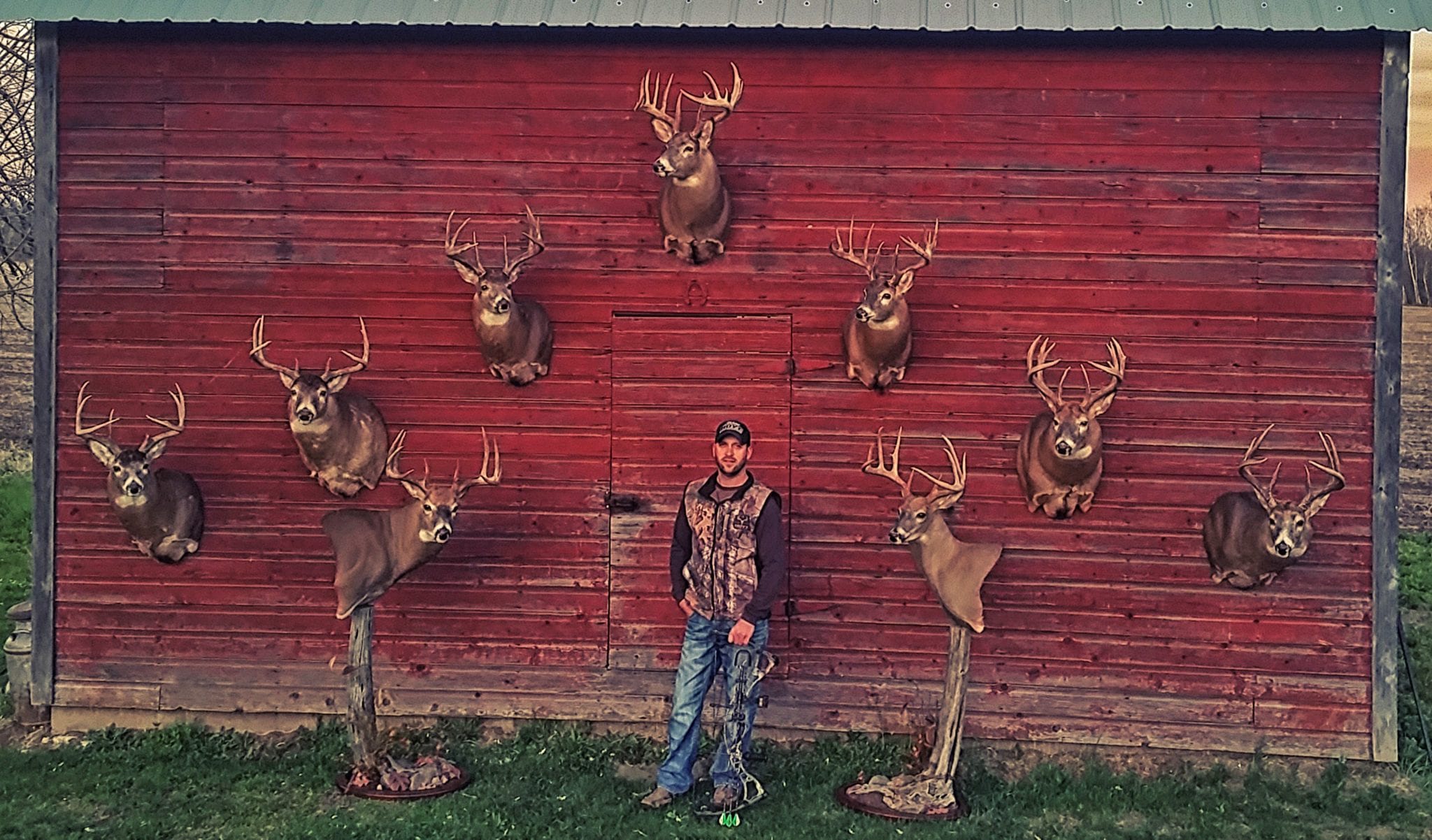
Aaron Knutson poses with nine white-tailed bucks – eight from Wisconsin and one from Iowa — that qualify for the Pope & Young Club’s Bowhunting Records book.
He’s also working on a streak of sorts. If he arrows a wall-hanger this year, it will be five straight years he’s bagged a record-book buck. Knutson doesn’t claim any unique skill or insight into deer behavior. He credits his consistent success to relentless summer scouting, usually from behind a spotting scope inside his truck or from a distant hillside.
“My main thing is that I watch deer all summer, and if I see one I like, I get obsessed,” Knutson said. “It’s game on. I’m out there every night watching for him. By the time bow season opens in September, I know when and where I want to be.”
One time you seldom find him bowhunting, however, is mornings. Because he’s a full-time dairy farmer, Knutson’s priority is milking his 50 cows each day at dawn. He might sneak out occasionally for a morning hunt during the rut, but only if he can find someone to handle the milking chores. Even so, morning hunts just aren’t important to him.
“I’ve never shot a buck in the morning,” Knutson said. “I’ve always had better luck toward evening, usually about 4 o’clock to 4:15 this time of year. I usually get all my chores done by 2:30 or so. Then I head to my tree stand, hunt till dark, and run back for the evening milking.”
And unlike many devoted big-buck bowhunters, Knutson has never sat in a tree stand dawn to dusk during the rut. It’s not for lack of will. “That 10 a.m. to 2 p.m. period is probably the best time to kill a buck during the rut, but it doesn’t fit my work schedule,” he said. “I’m usually too busy with chores to get out midday.”
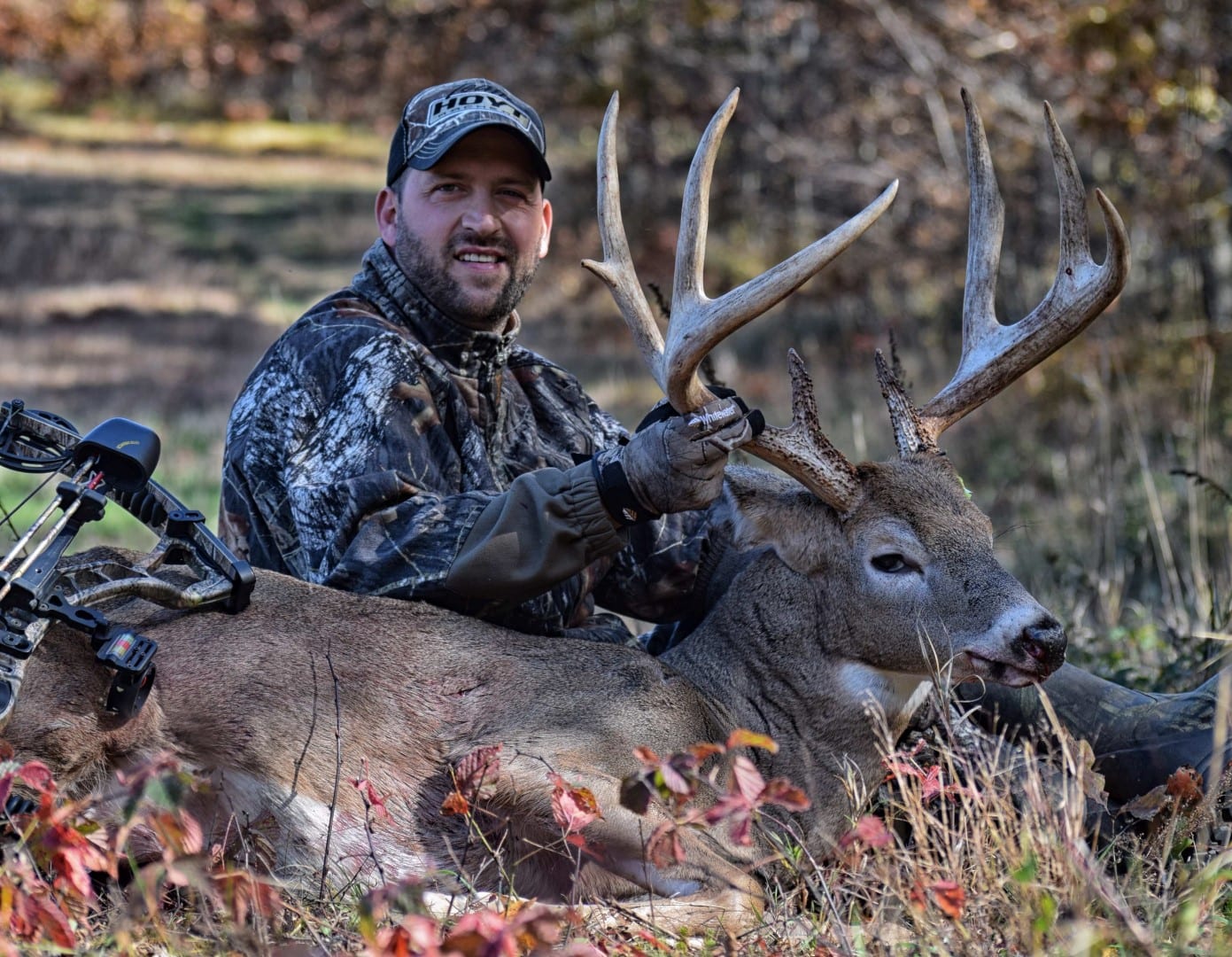
Aaron Knutson, 35, of Ridgeland, Wisconsin, usually arrows his bucks by early October when they’re still in their summer feeding patterns.
Knutson traces his love for bowhunting to his family. He arrowed his first buck in 1997 at age 17, and has been hooked on it ever since. “After I got that first buck, it was all I could think about,” he said. “I live for bowhunting, but so does everyone in my family. Nearly every one of my family members bowhunts or gun-hunts, and there’s a lot of us in this area.”
Knutson’s two favorite hunting sites are a friend’s 40-acre parcel, and another friend’s 200-acre property with a marsh, field and creek bottom. He said the 40-acre plot lies at the end of a 5- to 6-mile long ridge.
“The deer just pour off that ridgeline,” Knutson said. “It’s a real honey-hole.”
Although he sees lots of deer, not just any deer will do. And even though 4½-year-old bucks are uncommon almost everywhere in Wisconsin, they do exist. Knutson said a few older bucks survive in his area because several nearby properties seldom get hunted. And even those that do seldom see heavy pressure.
“Most people today just sneak in, sneak out, and never push deer off their property,” Knutson said. “That’s probably the biggest difference between hunting today and just a few years ago. No one does deer drives around here anymore during gun season. People complain they don’t see deer, but that’s only because no one drives the woods. The deer are still there.”
During archery season, of course, bowhunters patiently wait for deer to move on their own, either to eat or to breed. During gun season, once deer realize they’re being hunted, they hunker down during daylight.
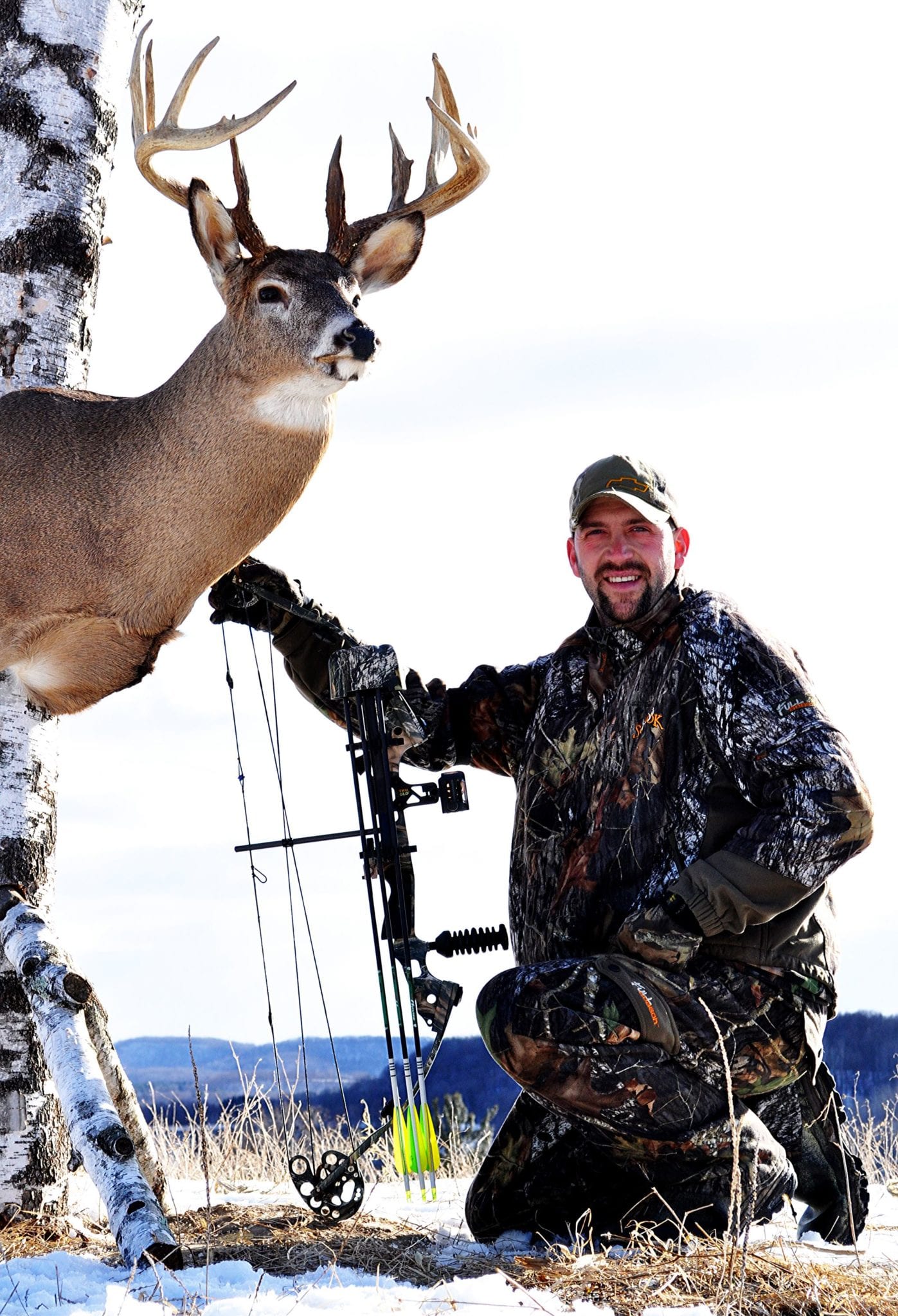
Aaron Knutson arrowed this buck in 2004 near his home in Dunn County. Its 13-point antlers tallied a gross score of 168 inches.
“They know when gun season rolls around,” Knutson said. “Those bucks won’t move during gun season unless a hot doe comes through and they chase her.”
He said the biggest mistake most bowhunters make is being careless about wind direction.
“You might take a chance during the rut when deer can come from any direction, but when you’re hunting the deer’s feeding patterns, you can only hunt specific winds,” Knutson said. “I used to take chances with wind, but I just educated the does. You can ruin the spot. Once the does are onto you, they’ll abandon entire fields, and you’ll never see that buck in daylight.”
Knutson’s biggest buck so far is a 13-pointer he arrowed in 2004. Its antlers had a gross Pope & Young score of 168, and entered the club’s record book with a net score of 161-6/8, which was Dunn County’s No. 7 deer for several years.
As with most of Knutson’s bucks, that one fell during archery season’s early weeks. But this year has been different. He had an encounter with a respectable buck early in the season, but held out for something bigger. Does he regret passing up that opportunity?
“No, I wouldn’t have been satisfied,” he said.